See the number.
Beat the number.
Real-time force and velocity feedback for every rep you lift.
Your training is missing data.
Incite captures force, velocity, and power on every rep in real time, so you stop guessing and start seeing what your body is actually producing.
Rating of perceived exertion shifts with fatigue, mood, sleep, and caffeine. Bar velocity is a direct, objective measure of neuromuscular output. When the number drops, you know you are fatiguing before you feel it. When it holds, you have more in the tank. No guesswork.
Research shows that athletes who receive immediate visual velocity feedback maintain significantly higher barbell velocities across a set, while also reporting increased motivation and competitiveness (Weakley et al., 2019). Beta testers consistently report completing 1-2 more reps per set and producing more force once the display is in front of them. It's something you can feel, and it's hard to go back to lifting without it.
Most training metrics are proxies. Force output is a direct measurement of what your body generates against the bar. Tracking it rep by rep reveals patterns invisible to the naked eye: compensation, fatigue onset, and whether your programming is actually working.
Closing the feedback gap.
Strength athletes generate enormous force but train almost entirely by feel. Subjective effort scales, fixed percentage programs, and post-hoc analysis leave performance data on the table. The result: missed peaks, stalled progress, and plateaus that instinct alone can't solve.
Incite exists to close that gap. A sensor that captures force and velocity on every rep, delivering real-time feedback to the athlete and structured data after the session. No camera setup needed. Just mount it, lift, and see the difference.
Attach in seconds.
N52 neodymium magnets snap directly to any steel weight stack, plate-loaded machine, or bare steel plates. A silicone foot keeps the grip locked. For barbells and dumbbells, the Velcro mount uses opposing-polarity magnets to lock the device in the correct orientation. Strap it to the sleeve, collar, or knurling -- three seconds, done.
Open the app and lift.
Select your workout in the Incite app and the device connects automatically over Bluetooth. After first-time pairing, connection is instant. Your exercise, load, and target reps are ready before you touch the bar.
Every rep, measured.
The device samples acceleration at 100 Hz with on-device signal conditioning, then streams data to your phone where all data points are derived in real time. You see the numbers as the set is happening, with feedback under 100 milliseconds from rep completion.
Know what actually happened.
After every set, Incite logs force output, peak velocity, velocity loss, estimated RPE, and mechanical work. After every session, you get a detailed breakdown with set-by-set data and a personalized analysis that identifies what went well, what changed, and what to do next.
Attach in seconds.
N52 neodymium magnets snap directly to any steel weight stack, plate-loaded machine, or bare steel plates. A silicone foot keeps the grip locked. For barbells and dumbbells, the Velcro mount uses opposing-polarity magnets to lock the device in the correct orientation. Strap it to the sleeve, collar, or knurling -- three seconds, done.
Open the app and lift.
Select your workout in the Incite app and the device connects automatically over Bluetooth. After first-time pairing, connection is instant. Your exercise, load, and target reps are ready before you touch the bar.
Every rep, measured.
The device samples acceleration at 100 Hz with on-device signal conditioning, then streams data to your phone where all data points are derived in real time. You see the numbers as the set is happening, with feedback under 100 milliseconds from rep completion.
Know what actually happened.
After every set, Incite logs force output, peak velocity, velocity loss, estimated RPE, and mechanical work. After every session, you get a detailed breakdown with set-by-set data and a personalized analysis that identifies what went well, what changed, and what to do next.
Weakley et al., 2019
J Strength Cond Res
Athletes who received real-time visual velocity feedback during back squats maintained significantly higher bar speed across the full set (0.70 vs 0.65 m/s) compared to a no-feedback control. The feedback group also reported higher motivation, competitiveness, and perceived workload.
Read Study →Wilson et al., 2017
Proc Hum Factors Ergon Soc
Rugby athletes who received real-time quantitative force feedback during strength training showed increased performance alongside higher ratings of competitiveness, state motivation, and mood. Participants described wanting to beat their own numbers, consistent with the effort amplification effect.
Read Study →17-Study Meta-Analysis, 2026
BMC Sports Sci Med Rehabil
A meta-analysis of 348 participants found velocity-based training produced significant improvements in jump performance and moderate improvements in change-of-direction ability over traditional percentage-based training. Real-time velocity feedback and daily load adjustment were identified as key differentiators.
Read Study →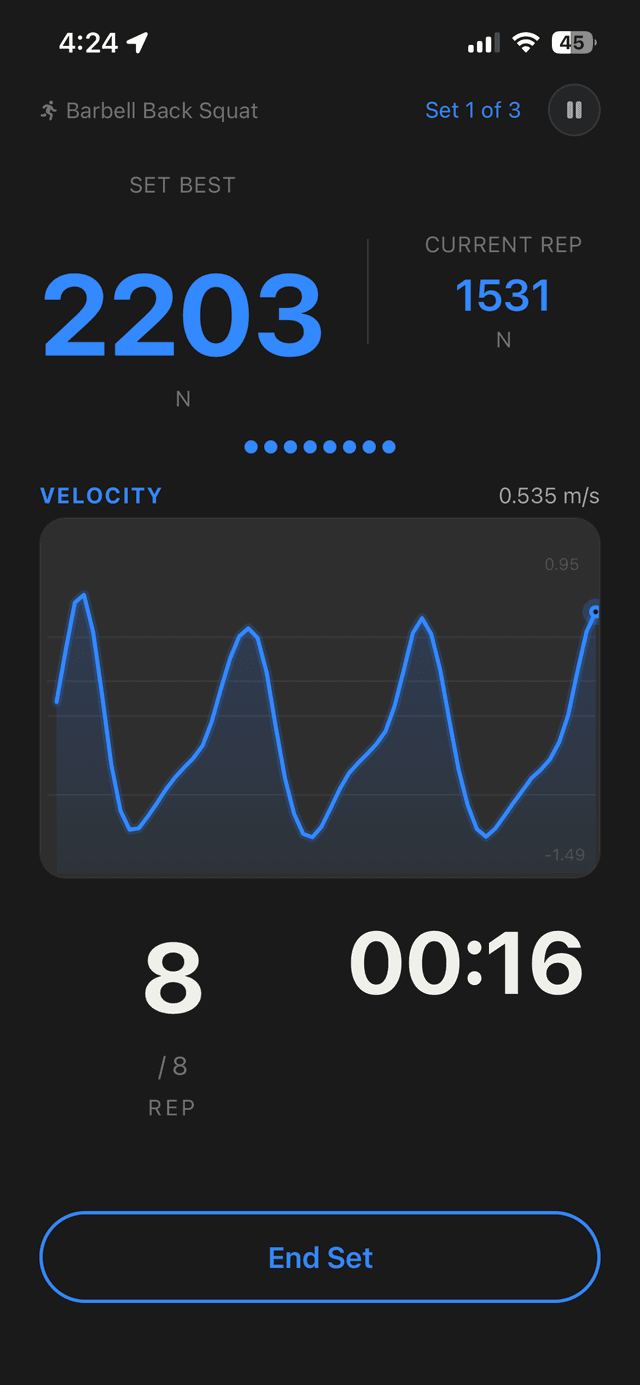
Force and velocity update live with rep-level feedback under 100ms. A dual display shows your set best and current rep force, color-coded by output zone. Velocity loss and fatigue indicators update as you go.
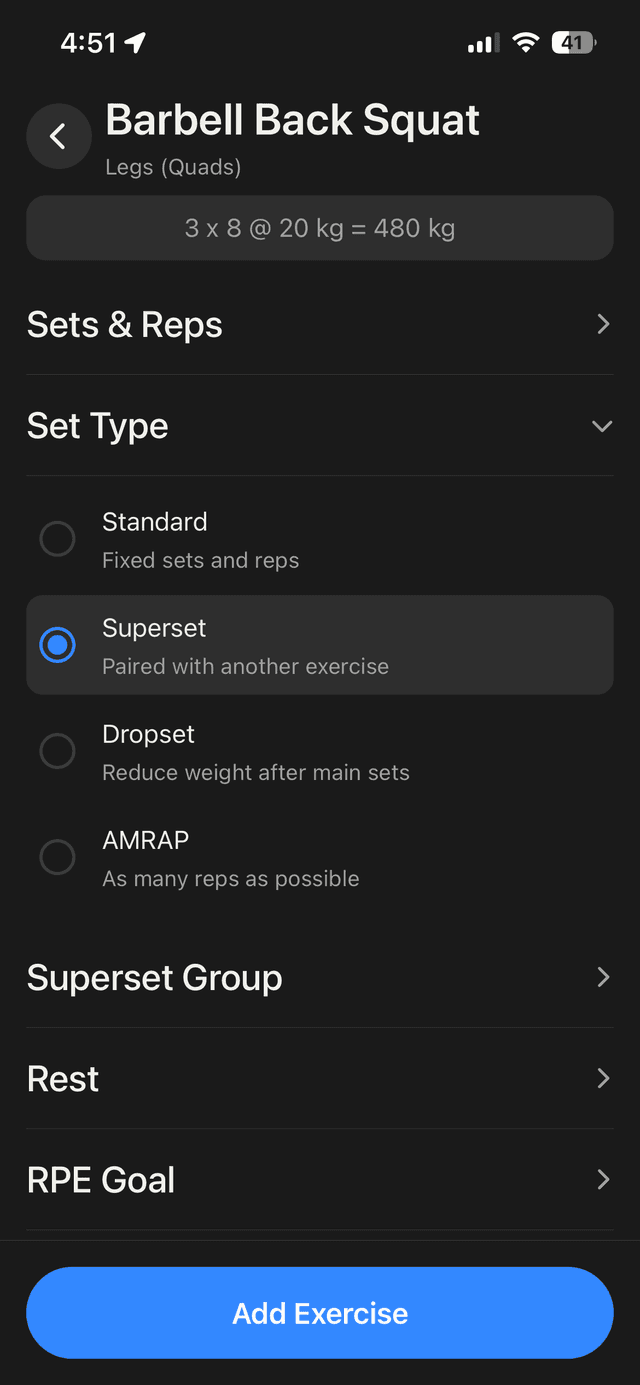
Create workout templates with exercises, sets, reps, and weight targets. Schedule them to days of the week, or days between sessions. Supports supersets, dropsets, AMRAP, custom rest timers, and RPE goals per exercise.
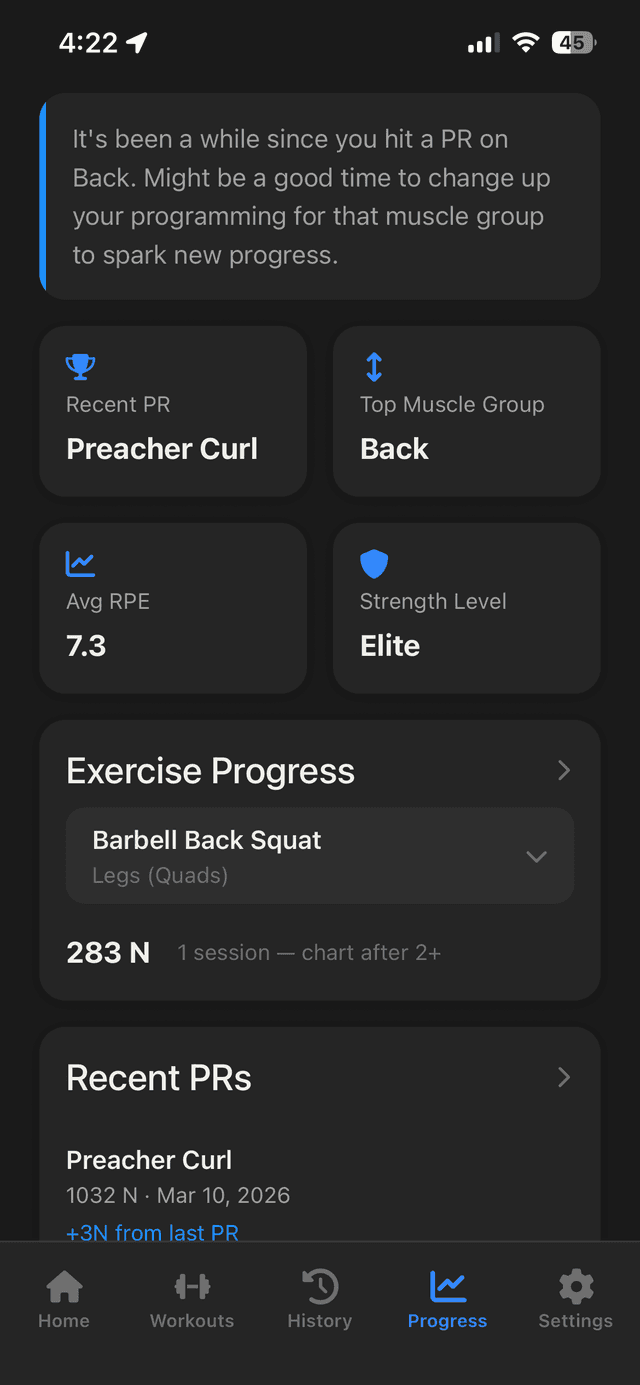
Track force trends, velocity changes, and volume distribution across configurable timeframes. Exercise-level cards show your trajectory. Strength standards give you context for where you stand relative to your bodyweight.
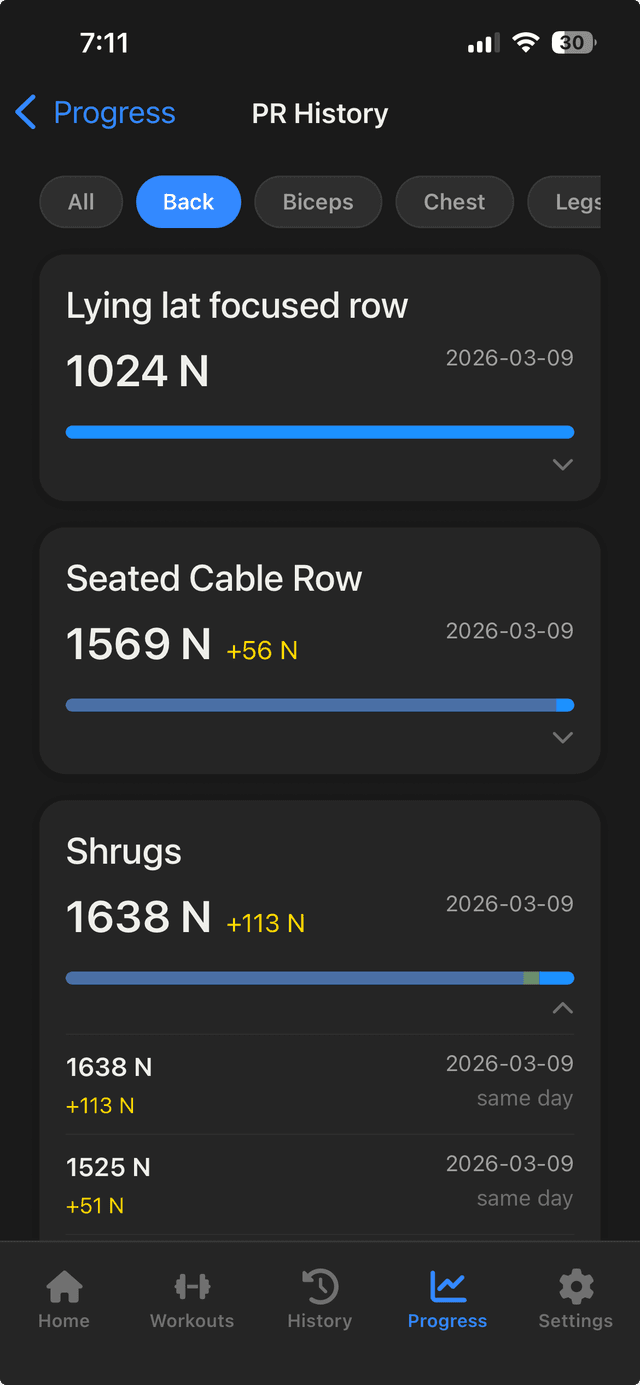
Every force PR across every exercise, automatically logged with date, load, and session context. See your PR trajectory over time and how frequently you are hitting new peaks.
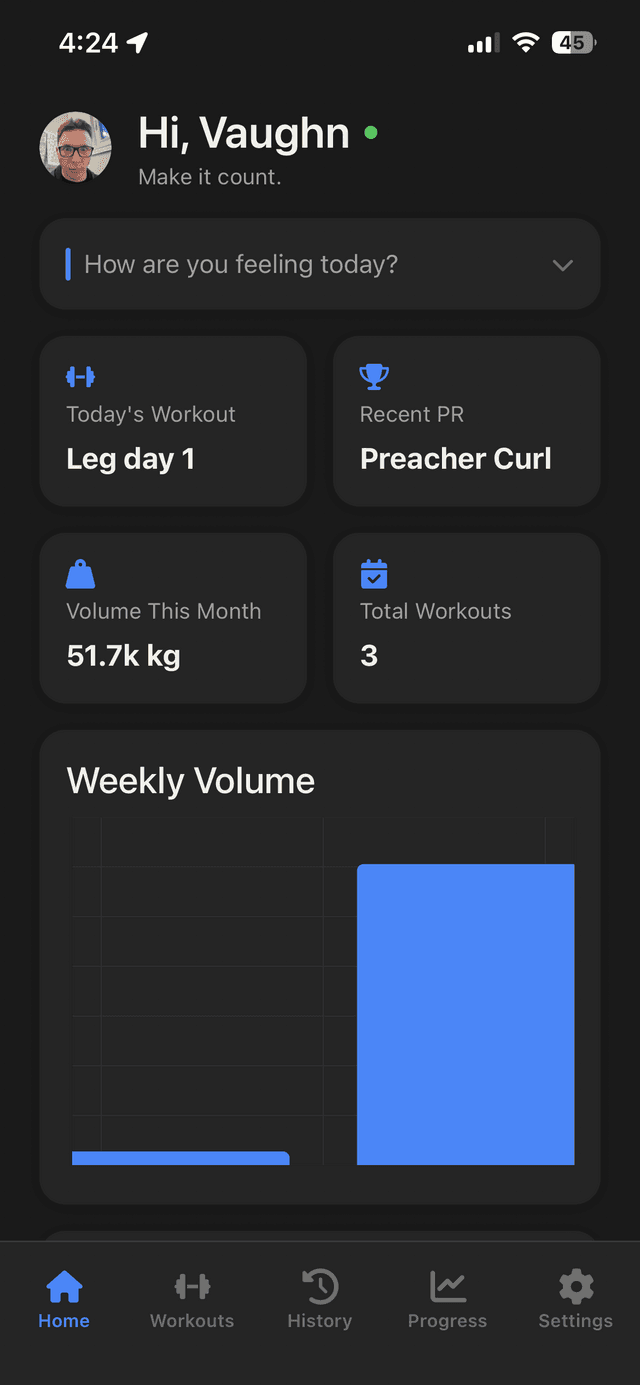
Monthly volume, total workouts, recent PRs, weekly volume trends, and muscle group distribution on one screen. A daily feeling tracker lets you log subjective readiness alongside objective data.
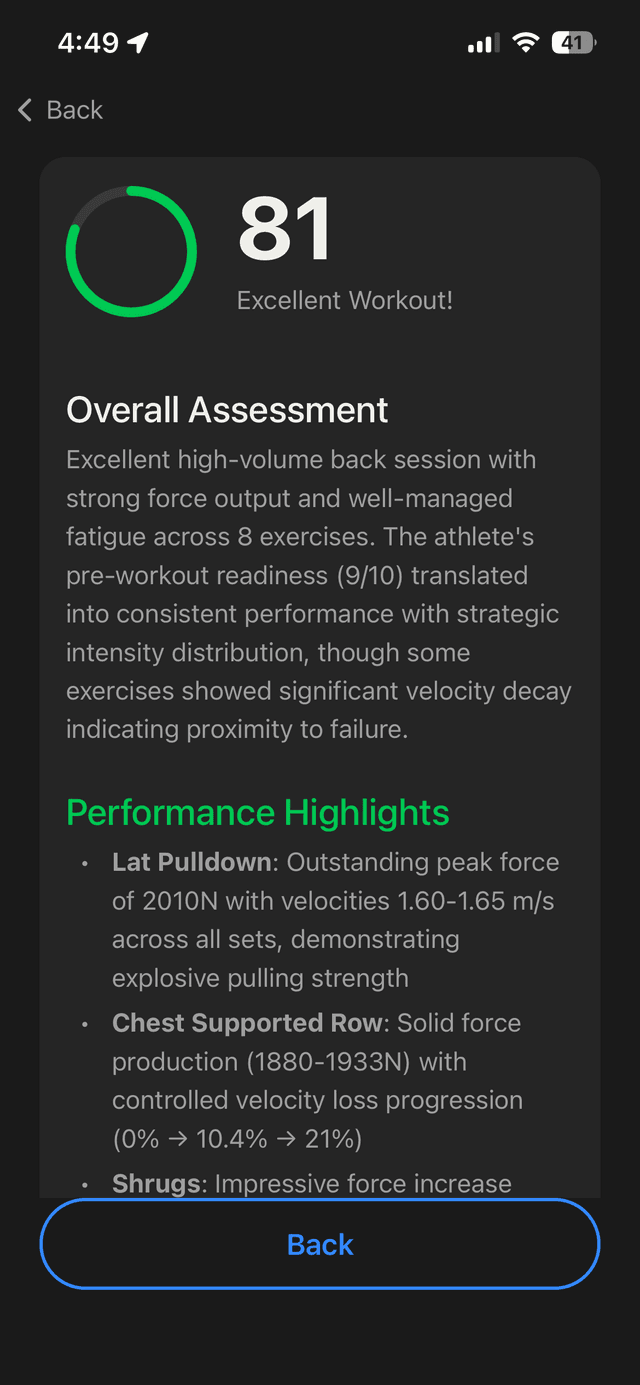
Set-by-set force, velocity, and rep data. Velocity loss classification outlines stimulus and fatigue levels. Session analysis identifies what went well, compares against previous sessions, and suggests adjustments.
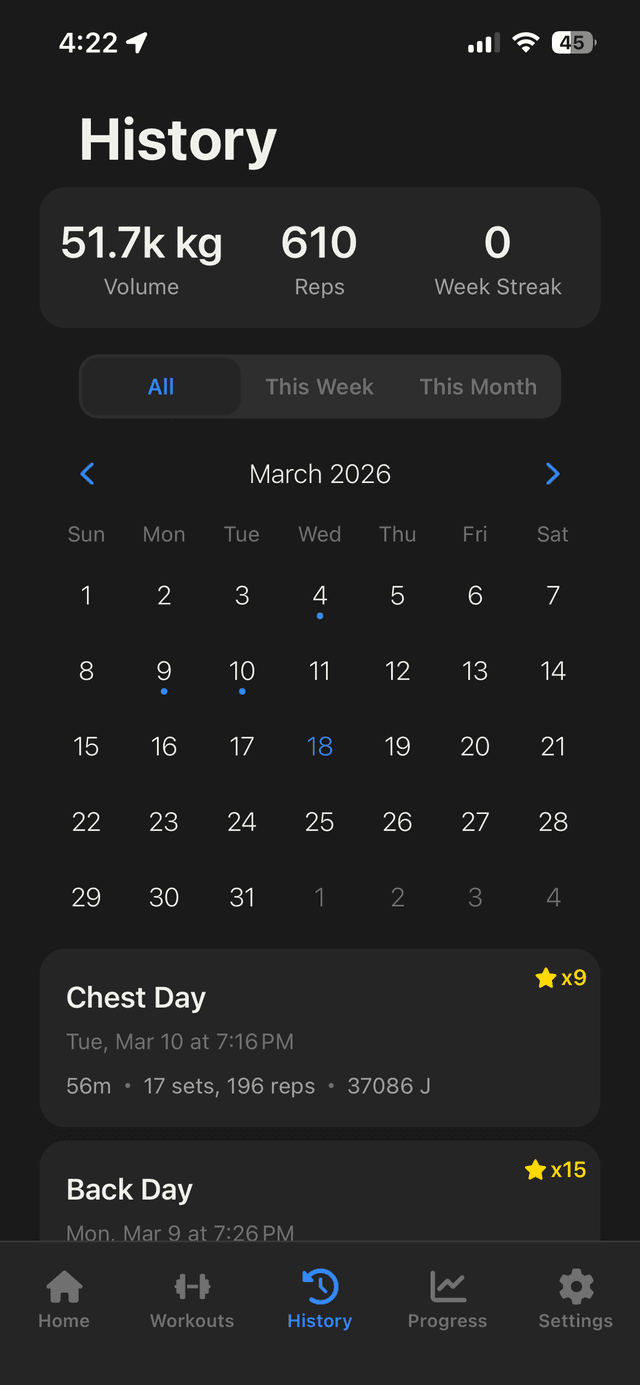
Every session stored with complete performance data. Calendar view with workout indicators, a trophy case for lifetime stats, and the ability to revisit any past session and its full analysis.
“I stopped guessing at RPE after the first session. The velocity numbers made my autoregulation actually objective for the first time.”
“The post-workout analysis is the real selling point. I genuinely look forward to reviewing my numbers after I leave the gym to know exactly how productive my lifts were.”
“I keep trying to beat the number from my last rep. It turned volume days from something I sandbag into something I compete with myself on.”